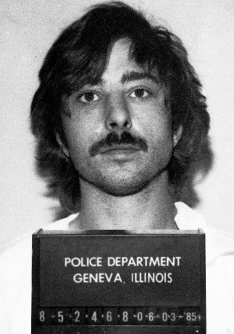
In the western suburbs of Chicago, a series of brutal crimes during the 1980s would eventually expose one of the most disturbing criminal cases in Illinois history.
At the center of that story was Brian James Dugan, a convicted rapist and serial killer whose crimes involved women and children.
But Dugan’s case became much bigger than the murders he committed.
Years before he was officially prosecuted for the killing of 10-year-old Jeanine Nicarico, two other men had already been convicted and sentenced to death for that crime.
Later, new evidence would overturn those convictions, and DNA would point investigators toward Dugan.
The case became a complicated story involving murder, wrongful convictions, disputed confessions, forensic evidence, and questions about how investigators handled one of the most heavily publicized murder cases in Illinois.
A Troubled Childhood
Brian Dugan was born on September 23, 1956, in Nashua, New Hampshire.
He grew up with his parents and four siblings. His family later moved to Lisle, Illinois, when Brian was a child.
According to accounts from relatives, Dugan’s childhood included a number of troubling incidents.
Family members described serious behavioral problems at an early age. They also recalled episodes involving violence and disturbing behavior toward animals.
At only eight years old, Dugan and one of his younger brothers were involved in setting fire to the family’s garage.
Several years later, his younger brother Steven alleged that Brian poured gasoline over a cat and set it on fire.
As Dugan grew older, his criminal behavior continued.
He ran away to Iowa in 1972 and was arrested that year on a burglary charge. Over the following years, he accumulated convictions involving crimes such as burglary, arson and battery.
There were also allegations of sexual misconduct and threats against family members.
By adulthood, Dugan had already developed a significant criminal record.
But the crimes that would eventually make his name notorious had not yet happened.
The Murder of Jeanine Nicarico
On February 25, 1983, 10-year-old Jeanine Nicarico was at her family’s home in Naperville, Illinois.
She was ill with the flu and had remained at home while her parents went to work and her sisters went to school.
At some point during the day, Jeanine disappeared.
Her family and investigators began searching for her.
Two days later, her body was discovered approximately six miles from her home.
She had been sexually assaulted and beaten to death.
The murder immediately became a major criminal investigation.
Police were under enormous pressure to identify the person responsible.
Instead of quickly finding the real killer, however, the investigation turned toward several young men from Aurora.
The Wrong Men
One of the people caught up in the investigation was Rolando Cruz, who was 20 years old at the time.
Cruz had provided police with information about the murder while apparently hoping to receive part of the reward offered for information leading to the killer.
His statements eventually drew investigators’ attention to him.
Cruz, along with Alejandro Hernandez and Stephen Buckley, became connected to the case.
The prosecution’s case against Cruz and Hernandez ultimately resulted in convictions for Jeanine’s murder.
Both men were sentenced to death.
Buckley’s trial ended differently when the jury could not reach a unanimous verdict.
For Cruz and Hernandez, however, the nightmare was far from over.
They maintained that they had not killed Jeanine.
And years later, evidence would begin to support their claims.
Meanwhile, Another Killer Was Still Free
While the Nicarico case was developing, Brian Dugan was continuing to commit violent crimes.
On July 15, 1984, Dugan encountered Donna Schnorr, a 27-year-old nurse from Geneva, Illinois.
According to investigators, Dugan followed Schnorr while she was driving and forced her vehicle off the road.
He attacked and sexually assaulted her before killing her by drowning her in a quarry.
The following year, his crimes escalated again.
The Attack on Sharon Grajek
On May 6, 1985, Dugan abducted and sexually assaulted 21-year-old Sharon Grajek in North Aurora.
Unlike his later victims, Grajek survived the attack.
Her survival would become important because Dugan’s criminal activity was about to come to an end.
A Dangerous Pattern
Later that month, Dugan attempted to abduct another young woman walking along a road near Aurora.
The attempt failed.
The following day, he successfully abducted and sexually assaulted a 16-year-old girl in the same general area.
Then, on June 2, 1985, Dugan encountered two young girls riding bicycles near Somonauk, Illinois.
They were 7-year-old Melissa Ackerman and her 8-year-old friend, Opal Horton.
Dugan approached them.
He grabbed Opal first and forced her toward his vehicle.
But she managed to escape.
Dugan then turned his attention to Melissa.
Melissa was not able to get away.
Dugan abducted and sexually assaulted her before killing her by drowning.
Her body was eventually discovered weeks later.
The Break in the Case
Opal’s escape gave investigators something they desperately needed: a description of the suspect and his vehicle.
The day after Melissa disappeared, police arrested Dugan at his workplace.
An earlier encounter between Dugan and a police officer over an expired vehicle inspection sticker had also brought attention to his car.
Investigators eventually connected Dugan to Melissa’s murder through physical evidence.
The evidence against him was strong enough that Dugan faced the possibility of a death sentence.
Instead, he entered into a plea agreement.
Dugan pleaded guilty to murdering Melissa Ackerman and Donna Schnorr.
He received two life sentences.
When asked why he had committed the crimes, Dugan reportedly could not provide a clear explanation.
His answer suggested that even he did not fully understand what had driven his actions.
But Dugan’s story was not finished.
A Confession About Jeanine
While Dugan was in custody for the Ackerman and Schnorr murders, he began talking about another killing.
The murder of Jeanine Nicarico.
Dugan had not originally been the focus of the Nicarico investigation.
Instead, Cruz and Hernandez had already been convicted.
But in 1985, Dugan informally claimed that he was responsible for Jeanine’s murder.
There was a catch.
Dugan wanted a deal.
He indicated that he would provide an official confession if doing so could protect him from the death penalty.
Prosecutors did not accept the proposed arrangement.
As a result, Dugan did not immediately provide the formal confession investigators wanted.
He later maintained that he had spoken up because he wanted responsibility for the crime placed where it belonged and wanted Cruz and Hernandez cleared.
But Cruz himself remained skeptical of Dugan’s motives.
The question surrounding Dugan’s confession would remain for years:
Was he telling the truth, or was he attempting to manipulate the legal system for his own benefit?
DNA Changed Everything
The Nicarico case eventually became a story of how advances in forensic science could transform an investigation.
Years after the original murder, DNA testing became increasingly sophisticated.
Investigators were able to compare biological evidence recovered from the crime scene with DNA from Dugan.
The results were significant.
Dugan’s DNA matched forensic evidence associated with the crime.
In 2005, more than two decades after Jeanine’s death, Dugan was formally indicted for her murder.
The case that had once sent two other men toward death row had finally come back to the man whose DNA connected him to the crime.
Justice for Jeanine — and Freedom for the Wrongfully Convicted
In 2009, Dugan pleaded guilty to Jeanine Nicarico’s murder.
A jury sentenced him to death.
But Illinois soon underwent a major change in its capital punishment laws.
In 2011, Illinois abolished the death penalty.
Dugan’s death sentence was therefore commuted to life imprisonment.
He remained incarcerated.
For Rolando Cruz and Alejandro Hernandez, however, the story had already taken another direction.
Cruz was eventually acquitted in 1995 after important testimony against him was recanted and DNA evidence excluded him from biological material recovered in the case.
Charges against Hernandez were also dismissed that same year.
Both men were ultimately freed.
Their years in prison, however, could never be returned to them.
The Investigation Itself Became a Controversy
The Nicarico case did not end simply with Dugan’s conviction.
The handling of the original investigation became the subject of another major legal battle.
In 1996, several DuPage County law-enforcement officials were prosecuted over allegations that they had conspired to frame Cruz and Hernandez.
The officials were acquitted.
Then, in 2000, Cruz, Hernandez and Stephen Buckley received a settlement from DuPage County related to their wrongful prosecution.
The case had become a powerful example of how an investigation can go badly wrong when authorities become convinced they have identified the perpetrators before the evidence is fully understood.
The John Wayne Gacy Claim
There was another disturbing chapter in Dugan’s history.
Dugan claimed that when he was a teenager in 1972, he had been sexually assaulted by notorious serial killer John Wayne Gacy.
According to Dugan’s account, he encountered a man at a grocery store in Lisle who offered him work.
The man allegedly took him to an isolated location, where Dugan said he was sexually abused.
Dugan later claimed that after Gacy’s arrest in 1978, he recognized him as the man from the grocery store.
However, the claim was never established as fact.
A prosecutor involved in the Gacy case publicly questioned Dugan’s account, pointing out inconsistencies and noting that the alleged encounter did not fit what was known about Gacy’s typical methods.
So the allegation remains part of Dugan’s story, but it should be treated as an unproven claim rather than an established fact.
A Case That Took Decades to Unravel
The Brian Dugan case is disturbing not only because of the crimes themselves, but because of everything surrounding them.
A child was murdered.
Two men were convicted of that murder and spent years facing the possibility of execution.
A third man eventually admitted responsibility.
Decades later, DNA evidence provided powerful scientific support connecting Dugan to the crime.
And the case became an enduring reminder that criminal investigations can have consequences reaching far beyond the courtroom.
For Jeanine Nicarico’s family, the loss began in February 1983 and could never be undone.
For Cruz and Hernandez, the consequences of being wrongly convicted lasted years.
And for investigators and prosecutors, the case became a lasting lesson about the importance of following evidence—even when the pressure to solve a horrific crime is enormous.
Brian Dugan ultimately remained behind bars for the rest of his life.
But the Nicarico case left a much larger legacy:
A conviction is not always the end of an investigation. Sometimes, the truth takes decades to emerge.
This article is based on publicly reported information about the Brian Dugan and Jeanine Nicarico cases. Some historical allegations, particularly claims concerning other individuals, remain disputed or unproven and are presented as such.
This story is based on publicly available information and reported facts. It has been independently written and presented for informational purposes. Images, if any, belong to their respective owners.