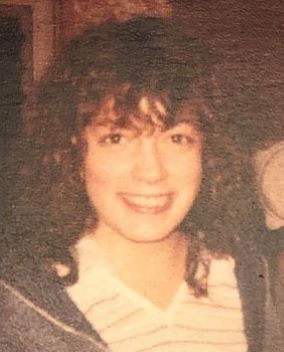
For nearly four decades, a teenage girl buried in a small New Jersey cemetery was known only as “Princess Doe.”
She had no confirmed name, no family waiting for her, and no clear explanation of how she had ended up dead in a quiet cemetery in Blairstown Township.
On July 15, 1982, her body was discovered in Cedar Ridge Cemetery. She had suffered severe injuries to her face, leaving investigators with very little to work with when they began trying to determine who she was.
For years, countless tips, missing-person reports, possible suspects, and forensic examinations produced more questions than answers.
Then, after almost 40 years, modern DNA technology finally gave her something she had been missing since the beginning:
her name.
She was Dawn Rita Olanick.
A Body Found in a Cemetery
The discovery was made on the morning of July 15, 1982.
George Kise, a gravedigger working at Cedar Ridge Cemetery, noticed something unusual near the rear of the property. Down a steep bank, close to a creek, he found the body of a teenage girl.
She was wearing a red short-sleeved shirt and a peasant-style skirt. She was not wearing underwear.
The condition of her face immediately made identification extremely difficult. She had been badly beaten, and investigators could not rely on facial recognition or ordinary missing-person photographs to determine who she was.
A gold cross necklace was tangled in her hair, and two earrings were found in her left ear. Her right hand still showed red nail polish.
Investigators carefully documented physical details that might eventually help identify her. She had no obvious surgical scars, tattoos, or distinctive birthmarks that could be confirmed. Her front two teeth were slightly darker than the others.
An examination later determined that she had never been pregnant or given birth.
Forensic specialists estimated that she was probably between 14 and 18 years old.
Because of decomposition and the conditions in which the body had been exposed, investigators could not establish exactly how long she had been outside. Estimates ranged from several days to potentially longer.
There was also no conclusive evidence establishing sexual assault.
What was clearer was that she had suffered significant trauma. Injuries to her hands and arms suggested that she may have tried to defend herself.
But the biggest mystery remained:
Who was she?
The Name “Princess Doe”
With no identity, investigators needed a way to refer to the young victim.
She eventually became known as Princess Doe.
The nickname came from Lieutenant Eric Kranz, one of the investigators involved in the case. The unusual name helped draw public attention to the investigation, and Princess Doe’s story soon received widespread media coverage.
She became one of the most recognizable unidentified murder victims in the United States.
Her case also became historically important because she was entered into the FBI’s National Crime Information Center as an unidentified crime victim. At the time, this was an important step toward creating greater national awareness of unidentified victims.
But publicity did not immediately bring her identity.
The Wrong Identity
One of the most significant developments came when investigators believed Princess Doe might be Diane Genice Dye, a California teenager who had disappeared from San Jose in 1979.
For years, the two cases were connected.
Some New Jersey officials became convinced enough that a press conference was held identifying Princess Doe as Dye.
But not everyone agreed.
Lieutenant Eric Kranz continued to question the identification, while Dye’s family and investigators in California also raised objections.
Eventually, DNA testing provided the answer.
In 2003, Princess Doe’s DNA was compared with DNA from Diane Dye’s mother, Patricia.
The results showed that the unidentified girl was not Diane Dye.
Once again, Princess Doe had no name.
The Kinlaw Connection
Another major lead surfaced in the late 1990s.
Authorities became interested in Arthur and Donna Kinlaw, a couple connected to murders in New Jersey and other states.
Donna Kinlaw was arrested in California after authorities discovered she had allegedly attempted to obtain welfare benefits using another name. During questioning, she provided investigators with information about murders involving her husband.
Donna eventually told authorities that Arthur had killed another woman earlier in 1982.
She also claimed that she had witnessed Arthur kill Princess Doe.
According to information provided by Donna, Arthur had brought a teenage girl home in July 1982. He later left with her and returned without her. Donna said he disposed of clothing, cleaned his vehicle and threatened her before going to work.
She reportedly understood from his statements that he had killed the girl.
Donna’s account led investigators to consider Arthur Kinlaw seriously as a possible killer.
However, there was a major problem.
Authorities could not find enough physical evidence directly connecting him to Princess Doe, the cemetery, and the exact time of the murder.
Investigators also questioned aspects of the confession because the Kinlaws could not provide the victim’s name.
Arthur remained incarcerated for other murders.
Princess Doe’s murder remained unresolved.
The Girl Seen Before Her Death
Investigators eventually discovered another potentially important clue.
A woman named Annemarie Latimer reported seeing a teenage girl at a supermarket on July 13, 1982—just two days before Princess Doe’s body was discovered.
The girl was wearing clothing similar to what was later found on the unidentified victim and was reportedly buying cigarettes.
The clothing itself became another avenue of investigation.
Its labels had been removed, but investigators traced the style to a manufacturer in the Midwest. Several people later said they had purchased similar clothing from a store on Long Island that had since closed.
This was significant because investigators increasingly believed Princess Doe might have had connections to Long Island.
Searching for Her Past
As the years passed, investigators tried to reconstruct where Princess Doe had lived before her death.
One theory was that she had been a runaway.
There were also indications that she may have used different names and possibly worked at a hotel in Ocean City, Maryland.
Scientific testing provided additional clues.
Isotope analysis of her hair and teeth suggested that she had likely been born somewhere in the United States. Her hair indicated that she may have spent at least several months living in either the Midwest or Northeast.
Other testing suggested a possible connection to Arizona.
Investigators nevertheless believed that Long Island could have played an important role in her life.
A 2012 reconstruction of her appearance generated new tips and led people to compare her likeness with several missing girls.
Still, no one could prove who she was.
Her Story Reached Television
Princess Doe’s mystery received enormous attention from television programs and documentaries.
The case appeared in the HBO documentary series MISSING, where Lieutenant Kranz discussed the investigation and the enormous number of leads generated after the body was discovered.
The program included footage connected to the recovery of Princess Doe and material from her 1983 funeral.
Her story was also featured on America’s Most Wanted, and CNN broadcast an updated reconstruction of the case in 2012.
Each appearance brought new attention.
Each new tip created another possibility.
But decades continued to pass.
A Grave Without a Name
Princess Doe was buried at Cedar Ridge Cemetery on January 22, 1983—more than five months after her body was discovered.
People donated money to provide her with a coffin and headstone.
Her grave became a place where strangers could remember a girl whose own family still did not know where she was.
The inscription on the headstone read:
“Princess Doe. Missing from home. Dead among strangers. Remembered by all.”
Over the years, memorial services were held in her honor.
On July 15, 2012, the 30th anniversary of her discovery, more than 100 people attended a memorial service. Clothing and facial reconstructions were displayed as investigators continued searching for answers.
In 2014, she was also honored at a missing-persons rally.
Although she remained unidentified, people refused to let her become forgotten.
A New Era of DNA Investigation
Modern forensic technology eventually gave investigators a new opportunity.
In November 2020, Princess Doe’s remains were exhumed again.
The goal was to obtain usable DNA material for advanced testing and genetic genealogy.
This was very different from the traditional DNA comparisons investigators had relied on decades earlier.
Instead of waiting for someone to recognize a photograph or match her to a missing-person record, investigators could use genetic information to search for biological relatives.
In 2021, investigators were connected with specialists who could attempt to extract DNA from the degraded remains.
Astrea Forensics worked on developing a usable genetic profile.
By February 2022, a successful DNA data file had finally been produced.
The information was then provided to genealogists working with the National Center for Missing & Exploited Children.
One of the genealogists, Jennifer Moore, worked on the case pro bono.
She began building a family tree from the genetic information.
Eventually, investigators found a promising lead.
Princess Doe Finally Has a Name
On February 22, 2022, genealogical research produced a candidate.
Investigators traveled to Long Island and met with members of the Olanick family.
Among them was Robert Olanick Jr., Dawn’s brother.
Additional DNA testing was conducted.
The results confirmed what investigators had spent nearly 40 years trying to learn.
The unidentified girl buried as Princess Doe was Dawn Rita Olanick.
Dawn had been born on August 5, 1964, and had lived in Bohemia, New York, with her mother and sister after her parents divorced.
According to her brother, Dawn left home around June 24, 1982, after her mother asked her to leave.
She never returned.
She was only 17 years old.
For decades, her family had no idea what had happened to her.
Now they finally knew where she had been all along.
The Investigation Turns Back Toward Arthur Kinlaw
Dawn’s identification also changed the investigation into her death.
Authorities began looking again at Arthur Kinlaw.
Investigators believe Dawn may have encountered Kinlaw before she was taken to New Jersey.
One theory is that Kinlaw wanted her to become involved in prostitution, but Dawn refused.
Investigators believe she was eventually driven to Blairstown, where she was killed at the cemetery.
Neither Dawn nor Kinlaw was known to have a connection to the town.
Kinlaw was later charged with homicide in connection with Dawn’s death, based on the broader investigation, witness accounts and statements attributed to him.
He remains incarcerated at Sullivan Correctional Facility in New York.
Investigators continue to work on reconstructing Dawn’s movements during the final weeks and days of her life.
Forty Years Without an Answer
The official identification was announced on July 15, 2022—the 40th anniversary of the discovery of Princess Doe’s body.
For four decades, the young woman had been remembered by a name that was never really hers.
“Princess Doe” was the name the public gave her because nobody knew who she was.
But Dawn Rita Olanick had a family.
She had a mother.
She had siblings.
She had a life before the cemetery, before the headlines, before the photographs and forensic sketches.
The investigation that began in a quiet New Jersey cemetery eventually crossed several states, involved countless investigators and generated decades of unanswered questions.
It took advanced DNA technology and genetic genealogy to finally give her identity back to her.
For 40 years, she was a mystery.
Now, she has a name.
Dawn Rita Olanick.
And her story is no longer about an unidentified girl called Princess Doe.
It is the story of a daughter and sister whose family finally learned what happened to her—and whose case continues to seek justice.
This story is based on publicly available information and reported facts. It has been independently written and presented for informational purposes. Images, if any, belong to their respective owners.