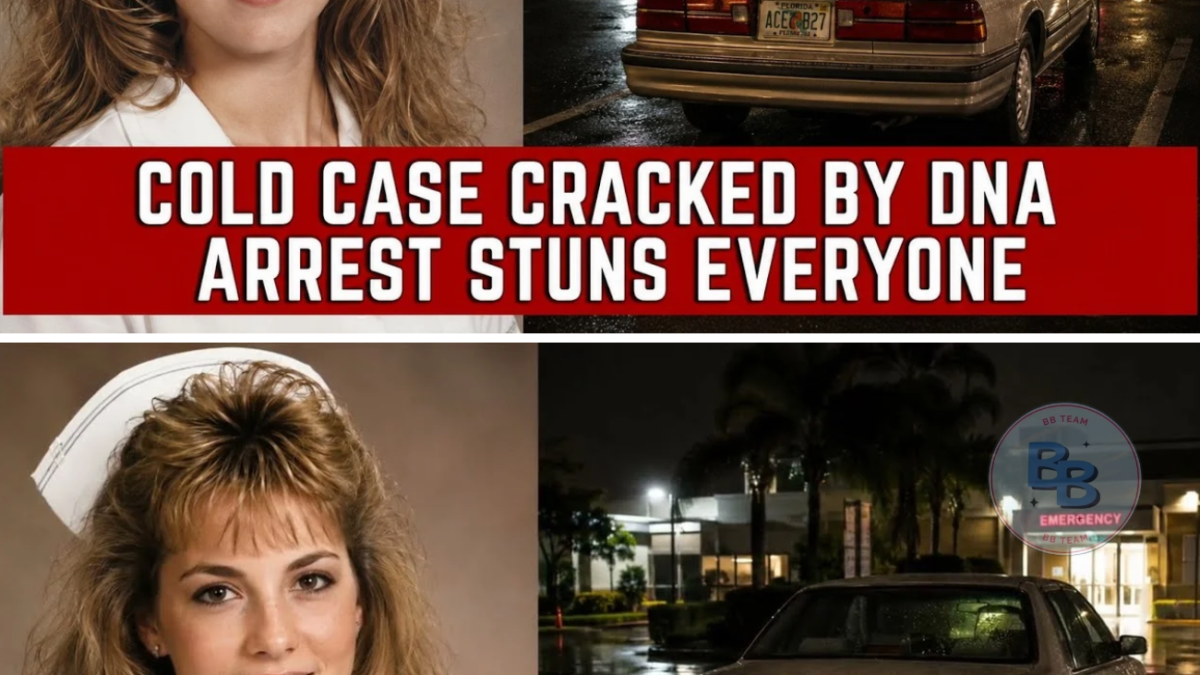
She Left the Hospital After Her Night Shift. Four Days Later, She Was Found Dead.
Citrus County, Florida — July 1992
At 26 years old, Renee Calloway had already built a life she was proud of.
She was a nurse. A daughter. A sister. A fiancée.
She had spent years working toward her career and was preparing for a future that seemed to be falling into place. In April 1992, she had become engaged to Kevin Alt, a history teacher she had been dating for two years.
The couple had even put down a deposit on a house.
Renee was imagining what that future would look like.
She would never get to live in it.
On the morning of July 10, 1992, Renee left the hospital after completing her night shift.
She never made it home.
The Woman Behind the Case
Renee had grown up in Citrus County.
She was remembered by people close to her as someone who cared deeply about others, a quality that was reflected in her work as a nurse.
She had worked night shifts several times a week and had developed a routine around the unusual hours. After finishing work in the morning, she would return to her apartment and sleep through much of the day.
Her younger brother, Marcus, was especially close to her.
Their father had died when Marcus was young, and Renee had become one of the people he relied on most.
They regularly spent time together, including Sunday dinners at Renee’s apartment.
Renee was also someone who held onto memories. She had kept a diary since childhood and wore a silver bracelet her grandmother had given her after she completed her medical education.
Her life was not finished being written.
Then came July 10.
The Last Morning
Renee arrived at work on the evening of July 9.
Her shift continued through the night.
Shortly after 7:00 the following morning, she finished and began walking toward the hospital’s service entrance.
At approximately 7:07 a.m., another nurse, Paula Tran, walked with her through the corridor and said goodbye near the exit.
Paula later recalled seeing Renee cross the parking area toward where she normally parked.
That was the last known sighting of her.
Renee’s fiancé, Kevin, expected her home that morning.
When she did not arrive, he began calling her apartment.
The calls went unanswered.
By early afternoon, Kevin was increasingly concerned.
He went first to Renee’s apartment and then to the hospital.
At approximately 2:15 p.m., he found her car.
The Car in the Hospital Parking Lot
Renee’s white 1989 Honda Civic was still parked near the service entrance.
The driver’s door was unlocked.
Her handbag was sitting on the passenger seat.
Her keys were inside the vehicle.
Her diary was on the back seat.
But Renee was gone.
There was no obvious sign of a struggle around the car.
No broken glass.
No blood.
No immediate indication of what had happened.
Kevin contacted the sheriff’s office.
Investigators arrived at the hospital parking lot and began reconstructing Renee’s final movements.
A search dog later followed a trail south along Citrus Avenue for several blocks before losing it near a highway turn.
But the trail did not lead investigators to Renee.
Four Days Later
For four days, there was no sign of her.
Then, a worker traveling along State Road 44 made a discovery approximately seven miles from the hospital.
Renee’s body was found in a drainage ditch beside a wooded area near an undeveloped lot.
She had been strangled.
The medical examiner determined that she had died only a few hours after leaving the hospital.
That meant the critical period was likely the early morning of July 10.
Somewhere between leaving work and the time her body was eventually found, Renee’s life had been taken.
And whoever was responsible had managed to leave very little behind.
The Evidence
Investigators recovered biological material from Renee’s clothing.
They also discovered a cigarette butt lying several feet from her body.
The cigarette was a Pall Mall, and its filter remained intact.
According to the case material, a detective recognized that the cigarette could potentially become valuable evidence as DNA technology advanced.
It was preserved.
Then the years began to pass.
At the time, forensic science could not provide the answer investigators needed.
But the evidence remained.
The Investigation
Detectives considered several possible explanations and examined multiple people connected to Renee’s life.
One man had previously attracted attention after reportedly appearing around the hospital and asking medical staff about Renee.
Investigators questioned him more than once, but he reportedly had an alibi that was supported by another person.
Another person investigated was Renee’s former boyfriend.
Their relationship had ended several years earlier without apparent hostility. He cooperated with investigators and eventually provided a DNA sample.
The sample did not match the biological evidence.
Investigators also considered a series of unsettling incidents Renee had reportedly mentioned before her death.
There had been strange noises near her apartment and an unexplained incident involving her door.
None of those events pointed conclusively toward a particular person.
By the end of 1993, the major investigative avenues had produced no answer.
Renee’s murder became a cold case.
A Community Searches
In the weeks following Renee’s disappearance, people throughout the community joined the search.
A candlelight vigil was held on July 24 at the Crystal River Public Library parking lot.
Hundreds of people attended.
Renee’s fiancé stood before the crowd but struggled to speak.
Her younger brother Marcus stood nearby.
Her mother, Dorothy, held a framed photograph of her daughter.
Among those helping organize the vigil was a local man named Dale Ostrosky.
At the time, there was nothing publicly connecting him to Renee’s disappearance.
He was known in the community as a volunteer firefighter and wrestling coach.
He also managed the apartment complex where Renee had lived.
He participated in the search for her.
He appeared in a local newspaper photograph carrying a flashlight while looking through wooded areas.
For years, the photograph would simply be remembered as an image of a community member trying to help.
The Case Goes Cold
As the years passed, Renee’s loved ones continued living with the absence.
Kevin eventually left Citrus County.
Marcus remained close to his mother and continued remembering the anniversary of Renee’s disappearance.
Renee’s mother kept her daughter’s photograph.
The original investigators eventually retired.
But the physical evidence remained in storage.
Among it was the cigarette butt recovered near Renee’s body.
The evidence could not speak in 1992.
But science was changing.
A New Opportunity
Decades later, forensic genetic genealogy began giving investigators new ways to examine unidentified DNA.
According to the case material, Florida eventually launched an initiative aimed at examining biological evidence from older unsolved cases.
Renee’s case was among those submitted for additional analysis.
In 2026, investigators reportedly received a genetic genealogy result that pointed toward a family network in the region.
The name that eventually emerged was startling.
It belonged to someone who had already appeared in the original investigation.
Dale Ostrosky.
The same man who had managed Renee’s apartment complex.
The same man who had participated in the search.
The same man who had helped organize the candlelight vigil held after her disappearance.
Looking at the Past Again
Investigators went back through the original case file.
They found Ostrosky’s name in the old interview records.
They also reportedly discovered maintenance records documenting his access to Renee’s apartment during the months before her murder.
Information that had seemed insignificant decades earlier was suddenly being viewed through a different lens.
Investigators sought additional evidence to compare against the DNA profile.
According to the case material, a covertly obtained sample was submitted for testing.
The results reportedly strengthened the connection investigators had uncovered through genetic genealogy.
After nearly 34 years, the investigation had returned to a man who had been there from the beginning.
The Arrest
On May 2, 2026, authorities reportedly arrested Dale Ostrosky at his home in Beverly Hills, Florida.
He was 76 years old.
The arrest shocked people who had known him for decades.
To them, Ostrosky had been a familiar figure—a firefighter, coach, neighbor, and community volunteer.
He had participated in the search for Renee.
He had stood among those mourning her.
And according to investigators, the evidence now pointed toward him as the person responsible for her murder.
Ostrosky was charged with first-degree murder and maintained his innocence.
The case material states that plea negotiations were underway at the time it was written.
The Most Disturbing Connection
Perhaps the most haunting part of the investigation was not simply that Ostrosky’s name appeared in the case decades later.
It was his connection to the aftermath.
If the investigators’ allegations are ultimately established in court, the man who had participated in the search for Renee had been searching for someone he allegedly knew he had killed.
He had stood beside the community as people looked for answers.
He had helped organize a memorial for her.
And for decades, Renee’s family had no idea that someone they had encountered during those painful months could eventually become the focus of the investigation.
Renee’s Life
Behind the case file was a 26-year-old woman who had plans for the future.
Renee had a fiancé.
She was preparing to move into a new home.
She had a brother who depended on her.
She had a mother who spent decades keeping her memory alive.
She had a diary she had maintained since she was a child.
She had a bracelet from her grandmother that she wore every day.
And she had chosen a profession built around helping frightened and vulnerable people.
On July 10, 1992, she went to work like she had done countless times before.
She expected to return home.
Instead, she disappeared from a hospital parking lot.
Thirty-Four Years Later
For decades, the cigarette butt recovered near Renee’s body was simply another piece of evidence in an old murder case.
Then forensic science caught up with it.
The DNA preserved from the scene reportedly helped investigators identify a man whose name had appeared in the original investigation.
Whether the case ultimately reaches a courtroom and what can be proven there will be determined through the legal process.
But after more than three decades, Renee Calloway’s name is no longer attached only to an unsolved murder.
Her case has been reopened, investigated with modern technology, and resulted in an arrest.
For her family, the passage of time did not erase the loss.
Renee was 26 when her life was taken.
She should have had decades ahead of her.
Instead, her family spent those decades waiting for answers.
And after 34 years, the evidence preserved from that summer morning in 1992 finally gave investigators a path back to the truth.
This story is based on publicly available information and reported facts. It has been independently written and presented for informational purposes. Images, if any, belong to their respective owners.