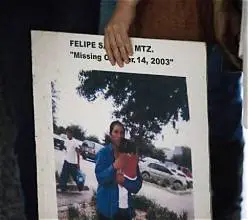
Felipe Santos, 23, was a Mexican national living illegally in the U.S. in nearby Immokalee, Florida. He had been living in the U.S. for three years at the time of his disappearance, and was sending money back to his family in Mexico. Santos was last seen October 14, 2003, at approximately 6:30 am. He was driving to work with his two brothers when he was involved in a minor car accident in Naples. Calkins cited Santos for reckless driving and driving without a license or insurance, and placed him in his patrol car. Santos was last seen riding away with Calkins.[2][9]
Later that day, Santos’s boss contacted the county jail to post bail, and it was discovered that Santos was never booked. Calkins claimed that he changed his mind about the arrest, because Santos was “polite and cooperative”, left him at a local Circle K, and drove off.[10] The reason for leaving Santos at a Circle K is unclear, as his place of work was close by and his foreman was on the way to pick him and his brothers up from the scene of the car accident.[6] The other driver in the accident said that Calkins was agitated about Santos’s lack of documentation. “He just stated that he was tired of pulling people over that didn’t have licenses,” she said.[2] In either case, there is no evidence that Santos ever arrived at the Circle K.[6] Calkins’ location after leaving the site of the accident was uncertain or unaccounted for nearly two hours.[6]
On October 29, two weeks later, after Calkins submitted his incident report, Santos’s family filed a missing persons report, as well as a complaint against Calkins.[6] An internal investigation cleared Calkins of any wrongdoing on November 27.[6] Santos’ wife, Apolonia Cruz-Cortez, has questioned the quality of the investigation into the disappearance, citing the fact that she has not been interviewed by investigators.[5]
Further investigation
Further suspicion was cast on Calkins when a recording of his call to dispatch requesting the tow of Williams’s car revealed further conflicting statements. In this recording, Calkins described the car as abandoned and blocking the road. This statement contradicted both his incident report and the witness statements, both of which reported that Calkins himself moved the vehicle to its location blocking the road. Calkins joked with the operator: “Maybe he’s out there in the cemetery. He’ll come back and his car will be gone.” He was also heard using inappropriate language during the call, describing the car as a “homie Cadillac”, and as a “piece of junk Cadillac”. Calkins defended his misstatements to the operator, telling investigators that he was just “joking around” with a coworker. Calkins insisted he moved the car to assist the towing company, as opposed to attempting to make it look abandoned.[11][12] Calkins also claimed in the recording that the car was disabled, which Williams’ family objects to, as a family member drove the car home from the tow yard.[6]
Approximately twenty minutes later, at 1:12 pm, Calkins requested a background check on “Terrance Williams”, giving an inaccurate birth date—a specific date that Williams had previously given the police when he was arrested. This contradicts Calkins’s earlier statement that he never knew Williams’s last name or any other personal details.[4][6] After this call, Calkins was unaccounted for nearly an hour; this period may actually be closer to two hours, as Calkins’ claims of other activities are not corroborated by any documentation.[6]
Calkins took three polygraph tests, one of which was inconclusive, one which indicated honesty, and one indicating deception.[6]
In this instance, the main person of interest in the case was a police officer, so the Florida Department of Law Enforcement and the FBI were called in to work on the case.[13] Various investigative techniques were used, including the covert placement of a GPS device on Calkins’s vehicle, and a forensic investigation of the patrol car. Cadaver dogs were used to survey the areas identified by the GPS, but these turned up no further evidence.[1] Calkins was subsequently fired from the department for providing conflicting information about both missing person cases, and for not cooperating with the investigation.[14]
Williams was legally declared dead in 2009.[6]
After Calkins left Florida in 2016, investigators searched his former home and the land it was on, but no human remains were found.
Increased publicity and lawsuit
The case went without any leads for a number of years until 2012, when a number of national programs began covering the case, including Disappeared, Anderson Cooper 360, and Dateline NBC. In 2017, the Investigation Discovery series Deadline: Crime with Tamron Hall investigated the disappearances of Williams and Santos.[15][16] Entertainment mogul Tyler Perry went on Al Sharpton‘s MSNBC talk show to discuss the disappearances, offering a $200,000 reward for information in connection with the cases.[1]
On August 30, 2018, a wrongful death lawsuit was filed against Calkins. The victims’ families were represented by civil rights attorney Benjamin Crump.[17][18] In 2020 Calkins’ attorney took a deposition from Marcia Williams, Terrance’s mother. Later that year, the case entered non-binding arbitration, with the arbitrator ultimately entering a nonbinding judgment in favor of Calkins. Although the Crump team attempted to appeal, a judge dismissed the case and ruled that Marcia Williams had to pay Calkins around $5,600 for costs related to the lawsuit.[6]
Tyler Perry released a documentary series titled Never Seen Again in May 2022 which addresses the disappearances of the two men.[3]
Theories
One theory posited by the Sheriff’s Department is that both men left of their own accord to avoid trouble with the law, as Santos was undocumented and Williams had a warrant related to unpaid child support. However, both men’s families deny this, pointing to their strong relationships with their families and children. A Sunoco clerk claimed that he had seen Williams alive in the store on January 19, 2004, but surveillance footage from that day does not show Williams in the building. Workers on the case say there is no evidence that Williams has been seen again since his encounter with Calkins.[6]
A popular theory for the disappearances is the Starlight Tour theory. The term originated in the Canadian province of Saskatchewan, and describes the practice of police driving Indigenous individuals to the edge of town or outside of city limits, and abandoning them to find their own way home or die from the cold.[19] The practice came to light in 2000, when an Indigenous Canadian man named Darrel Night reported being picked up by police after leaving a party, driven to the outside of town, and then dropped off in a rural area in freezing conditions. Night survived after finding a nearby power plant staffed by a security guard. The next morning, another Indigenous man named Rodney Naistus was found frozen to the ground near where Night was dropped off. Lawrence Wegner, also Indigenous, was found deceased weeks later in the same area. According to Russ Sabo, Saskatoon‘s new police chief, evidence exists that similar drop-offs have gone on since at least the 1970s.[20]
A number of podcasts have explored the theory that Santos and Williams were dropped off in the nearby Everglades, and had died of exposure or other perils.[21][22] However, NPR podcast The Last Ride claimed in 2023 that Calkins would not have had time to drive to the Everglades, based on his other confirmed locations that day.[23]
One anonymous former sheriff’s office employee has suggested additional people besides Calkins may have been involved in the men’s disappearances, although no evidence has been uncovered to support this.[6]
Credit by: Reddit.com