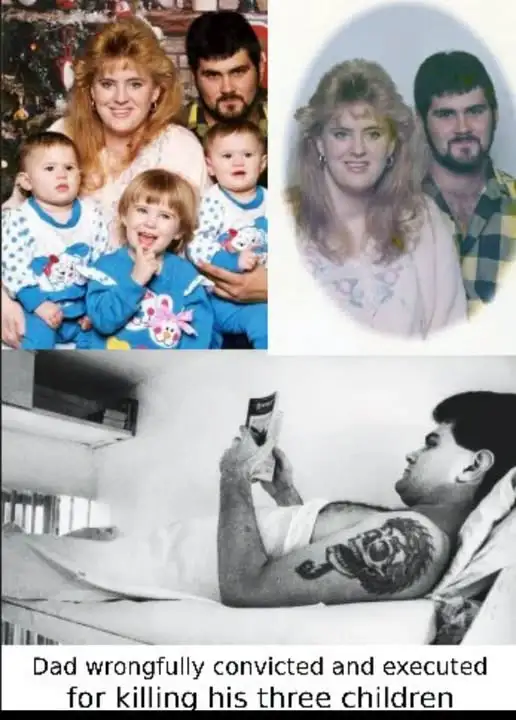
On the morning of December 23, 1991, a devastating fire destroyed the Willingham family home in Corsicana, Texas.
Inside the house were Cameron Todd Willingham and his three young daughters: 2-year-old Amber Kuykendall and 1-year-old twins Karmon and Kameron Willingham.
Their mother, Stacy Kuykendall, was away buying Christmas presents.
Cameron survived the fire.
His three children did not.
What followed would become one of the most controversial criminal cases in the history of Texas—a case involving three dead children, a father sentenced to death, disputed fire science, and questions that continued long after the execution.
Willingham always maintained that he had not intentionally started the fire.
But investigators soon reached a very different conclusion.
Three Children Lost Before Christmas
The tragedy happened only two days before Christmas.
The three girls were still very young. Their deaths devastated their family and shocked the small Texas community.
Cameron told investigators that he had been asleep when the fire began. According to his account, he woke up after hearing one of his daughters and realized the house was on fire.
He tried to reach his children but could not get them out.
He escaped the burning house himself and suffered injuries.
But the three children remained trapped inside.
For the investigators arriving at the scene, the first question was simple:
How had the fire started?
That question would eventually determine the fate of Cameron Willingham.
When the Fire Became a Murder Investigation
At first, this could have been treated as a terrible accidental house fire.
Instead, investigators concluded that the fire had been deliberately set.
They pointed to several features of the burned house that they believed were signs of arson.
At the time, fire investigators commonly relied on patterns in burned buildings to determine whether a fire had been intentionally started.
Investigators interpreted certain burn patterns, damage to the floors and other features as evidence that an accelerant had been used.
Those conclusions became the foundation of the prosecution’s case.
If the fire was accidental, Cameron was a grieving father who had lost his children.
If the fire had been deliberately started, investigators needed to find out who had done it.
Their attention turned toward Cameron.
Why Did Investigators Suspect Cameron?
There was no stranger caught running from the house.
There was no obvious burglar.
And Cameron was inside the home when the fire began.
As investigators examined the circumstances, suspicion increasingly focused on him.
Prosecutors eventually argued that Cameron had intentionally started the fire and killed his own children.
The motive presented by the prosecution became another controversial part of the case.
Cameron, however, denied murdering his children.
He continued to say that the fire was not something he had intentionally started.
His defense would eventually have to fight not only the accusation of murder, but also the scientific conclusions being used to prove that the fire itself was arson.
The Arson Evidence
The fire investigation became the centerpiece of the case.
Investigators testified about burn patterns and other physical evidence that they believed showed the presence of an accelerant and an intentionally set fire.
At Cameron’s 1992 trial, these conclusions carried enormous weight.
But years later, fire scientists would question the scientific foundation behind those conclusions.
According to later independent reviews, several of the supposed indicators of arson had been based on outdated theories about how fires behave.
The problem was enormous.
If investigators were wrong about the fire being arson, then the entire murder case rested on a deeply flawed foundation.
The Jailhouse Informant
The prosecution also relied on testimony from a jailhouse informant named Johnny E. Webb.
Webb claimed that Willingham had confessed to him.
His testimony became another important piece of the prosecution’s case.
Years later, however, Webb’s credibility was heavily challenged, and he eventually recanted his testimony.
The controversy surrounding his evidence added another layer of doubt to the case.
Critics argued that once the disputed arson evidence and informant testimony were questioned, very little remained to establish that Cameron had deliberately killed his children.
The Innocence Project later described the forensic evidence as the centerpiece of the prosecution’s case.
Cameron Willingham’s Trial
In 1992, Cameron Todd Willingham went on trial for the deaths of his three daughters.
The prosecution presented the fire as an intentional act.
Fire investigators testified that the physical evidence showed that someone had deliberately set the blaze.
The jailhouse informant testified that Willingham had confessed.
Cameron’s defense maintained that he had not murdered his children.
But the jury ultimately found him guilty.
He was convicted of capital murder and sentenced to death.
For Cameron, the tragedy that had begun with the deaths of his daughters had now become a fight for his own life.
The Death Sentence
Cameron was sent to death row.
He continued to maintain that he was innocent.
Over the following years, his attorneys challenged his conviction and sought to stop his execution.
But the conviction remained in place.
As the years passed, the evidence used to convict him began receiving increasing scrutiny from independent fire experts.
And this is where the story took a dramatic turn.
The Fire Science Begins to Change
Fire investigation was changing.
Some methods that had once been treated as reliable indicators of arson were increasingly being questioned by scientists.
Experts began studying how accidental fires could create burn patterns that investigators had previously interpreted as evidence of deliberate ignition.
In Willingham’s case, independent experts examined the original evidence and reached troubling conclusions.
A five-member panel of leading arson experts reviewed more than 1,000 pages of evidence and official documents. They concluded that the forensic interpretations used in Willingham’s case were scientifically invalid.
Another expert, Gerald Hurst, reviewed the case and concluded that there was no reliable scientific basis for calling the fire arson.
The Report That Arrived Before the Execution
Perhaps the most disturbing part of the story came shortly before Cameron’s execution.
His attorneys obtained a report from Gerald Hurst, a nationally recognized fire expert.
Hurst challenged the arson conclusions used to convict Willingham.
The report was sent to Texas officials before the execution.
But the execution went ahead.
Cameron Todd Willingham was executed by lethal injection in Huntsville, Texas, on February 17, 2004.
He was 36 years old.
He died still maintaining that he had not intentionally killed his children.
The Questions Did Not Die With Him
Cameron’s execution might have ended the legal process.
But it did not end the questions.
Months after his execution, investigative reporting brought renewed attention to the case.
Independent fire experts examined the evidence again.
Their conclusions were deeply troubling.
They argued that the original investigators had relied on outdated fire-investigation theories and that the supposed indicators of arson did not reliably prove that someone had intentionally started the fire.
The central question was no longer simply:
Did Cameron Willingham murder his children?
It became:
What if the fire was never arson in the first place?
Nine Experts Reexamine the Case
Over the years, numerous respected fire experts examined Willingham’s case.
The Innocence Project reported that nine nationally recognized independent experts reviewed the evidence and concluded that the original forensic analysis was seriously flawed.
That did not automatically prove who—or what—caused the fire.
But it created a serious problem for the original conviction.
The scientific evidence that had been used to establish arson was now being challenged by modern fire science.
The Texas Forensic Science Commission eventually examined the controversy.
Its work highlighted concerns about unreliable fire-investigation methods and recommended improvements in training and review of older cases.
Could the Fire Have Been Accidental?
This is the question that has made the Willingham case so famous.
Later experts argued that the fire could have been accidental and that the original investigators had misinterpreted the evidence.
Some experts went even further, saying that there was no reliable evidence proving the fire was intentionally set.
The Innocence Project and other organizations have argued that Willingham was wrongfully convicted and executed.
However, it is important to distinguish between scientific criticism of the arson evidence and a formal legal declaration of innocence.
Willingham’s conviction was not overturned during his lifetime, and after his execution there was no conventional retrial establishing his innocence.
So the most accurate description is that his conviction and execution remain highly controversial, with substantial expert criticism of the forensic evidence used against him.
The Story of a Father Who Never Stopped Denying It
Throughout the case, Cameron maintained that he had not intentionally started the fire.
His supporters argued that he had been wrongly accused because investigators had interpreted an accidental fire as arson.
Critics of the wrongful-conviction theory have pointed to other circumstances surrounding the case and have continued to dispute the claim that the evidence proved his innocence.
That disagreement is part of what makes the case so difficult.
There is no simple ending.
There is a dead father.
Three dead children.
A destroyed home.
A conviction.
An execution.
And years later, experts saying that the science used to reach the original conclusion was deeply flawed.
A Case That Changed the Conversation About Arson Investigations
The Willingham case became an important example in discussions about the reliability of forensic fire investigation.
For decades, investigators had sometimes relied on visual burn patterns and traditional beliefs about how deliberately set fires behaved.
Modern fire science showed that fire behavior can be far more complicated.
A pattern that looks suspicious does not automatically mean that an accelerant was used.
A particular type of burning does not automatically prove that someone intentionally started a fire.
And when a person’s life depends on those conclusions, the consequences of getting them wrong can be irreversible.
In Willingham’s case, the consequence was exactly that.
He was executed.
The Final Question
On December 23, 1991, three little girls died in a house fire in Corsicana, Texas.
Thirteen years later, their father was executed for allegedly causing that fire.
But after his death, scientists and investigators returned to the evidence and challenged the very foundation of the prosecution’s case.
That leaves one haunting question:
Was Cameron Todd Willingham a murderer who escaped justice until after his execution—or was he an innocent father who was wrongly convicted because investigators misunderstood the fire?
There is no courtroom verdict today that can bring Cameron back or give his daughters another Christmas.
But his case remains a warning about something far bigger than one family.
When science is misunderstood, a mistake in an investigation can become a mistake in a courtroom—and a courtroom mistake can become irreversible.
The fire destroyed a house in 1991.
But the questions surrounding it have continued to burn for decades.
Credit by: Emmi