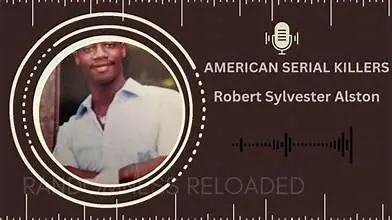
Between 1991 and 1993, a series of killings in Greensboro, North Carolina, left investigators facing a disturbing pattern. Four women were murdered, and their bodies were concealed or dismembered in different locations around the city.
The man eventually held responsible was Robert Sylvester Alston, a Greensboro native who later admitted responsibility for all four killings. His case became even more unusual because of the anonymous tips that helped police locate victims’ remains. Investigators came to believe that Alston himself may have been behind some of those calls, although he never acknowledged being the anonymous informant.
Alston ultimately pleaded guilty and received consecutive life sentences.
A Troubled and Isolated Young Man
Robert Sylvester Alston was born in Greensboro on May 19, 1969. His parents, Jack and Dorothy Alston, came from working-class backgrounds, with his father employed as a school custodian and his mother working in a factory.
At Grimsley High School, Alston was described as quiet and socially isolated. He had difficulty connecting with other students and apparently maintained few close friendships. Although he was tall and physically capable, he showed little interest in school activities. His only involvement was with the Reserve Officers’ Training Corps, although he reportedly paid little attention to it.
After graduating in 1987, Alston enrolled at a junior college in Georgia. His interest in school quickly disappeared, and he left after only one semester.
A relationship during his late teenage years resulted in the birth of his first child in 1989. Alston and his girlfriend later moved to Wilmington, Delaware, where they had another child in 1991.
The relationship eventually broke down. Alston left his partner and children and returned to Greensboro, moving back in with his parents. Over the following years, he held a series of low-paying jobs.
By the time police arrested him in 1994, he was working as a dishwasher at the Rock-Ola Cafe on Battleground Avenue.
People who knew him described a man who kept largely to himself. Even his relationship with his parents was reportedly distant, with his father later describing a lack of emotional closeness and trust within the family.
The First Victim
Alston’s first confirmed victim was 23-year-old JoAnne Robinson, a woman struggling with crack cocaine addiction who was also working as a prostitute.
In April 1991, Robinson was strangled. Her body was later discovered only a few blocks from Alston’s home.
At the time, investigators had no reason to know that her death would become the first confirmed case in a series of murders.
Sharon Martin Disappears
Several months later, another woman, 26-year-old Sharon Martin, became Alston’s second confirmed victim.
Martin was strangled in October 1991. After her death, her body was dismembered and the remains were left in different parts of Greensboro.
Toward the end of November, workers in the area made a horrifying discovery in a wooded location near Jackson Middle School. Some of Martin’s remains were found there, including her head and one of her hands.
The discovery intensified concerns that Greensboro might be dealing with a serial killer.
The Death of Shameca Warren
The next known victim was 19-year-old Shameca Warren.
Warren was a young woman who struggled with drug addiction and prostitution. Her family had reported her missing in May 1992.
Sometime during the spring of that year, she was killed. Police eventually discovered her body at an abandoned property near Alston’s residence.
Like the earlier cases, Warren’s death contained similarities that would later become important to investigators.
Lois Williams
The fourth confirmed victim was 41-year-old Lois Elizabeth Williams.
Williams had previously worked as a manager for the News & Record. After losing her job, however, her life deteriorated. She eventually became involved with crack cocaine and prostitution.
In December 1993, Williams was raped and strangled.
Her body was found on December 14 at Piedmont National Cemetery.
Witness interviews gave detectives an important lead. Williams had reportedly been seen shortly before her disappearance with a Black man who appeared to be approximately six feet tall and weighed around 185 pounds.
Investigators also learned that anonymous information had helped authorities locate the bodies of Williams and Warren.
Whoever was making those calls appeared to know details about the crimes.
An Attack That Finally Gave Police a Suspect
The breakthrough came in January 1994, although it began with a crime that Alston had not yet been publicly connected to.
A 29-year-old woman was attempting to hitchhike back toward Greensboro when Alston offered her a ride.
Instead of taking her home, he drove toward a wooded area near James B. Dudley High School.
There, he attacked her and attempted to kill her. After she lost consciousness, he threw her from a bridge into a nearby river.
Remarkably, she survived.
The woman was rescued and taken to a hospital. Once she recovered enough to speak with investigators, she provided a description of her attacker.
Police created a facial composite and began examining possible suspects.
At the police station, the victim was shown photographs of several men who had previously been convicted of crimes. One photograph immediately stood out to her.
It belonged to Robert Alston.
Although Alston had never previously been arrested, investigators were already interested in him because several of the murdered women had been found close to his neighborhood.
On January 28, 1994, police arrested him.
The surviving victim subsequently identified Alston as the man who had attacked her.
Then came an unexpected development.
During questioning, Alston confessed to killing Lois Williams.
Confessions Bring More Cases to Light
Alston was convicted of Williams’ murder in April 1994 and received a life sentence.
But investigators continued to suspect that he was connected to the other killings.
For a time, Alston denied responsibility.
That changed in 1996.
He contacted the Guilford County Prosecutor’s Office and admitted that he had killed JoAnne Robinson. The confession resulted in another murder charge, and on August 19, 1996, he was convicted and given another life sentence.
Then, in late 1997, Alston made another startling confession.
This time, he claimed responsibility for the deaths of Sharon Martin and Shameca Warren.
Investigators struggled to find physical evidence directly connecting him to those two murders. Nevertheless, prosecutors presented the cases to a grand jury, and Alston was indicted for both killings in January 1998.
There was still one major problem.
Authorities needed to know where the victims’ remains were located.
The Mystery of the Anonymous Caller
Alston refused to explain his motives fully and would not tell investigators where Martin and Warren had been buried.
Yet police eventually received anonymous information that led them to the remains.
Investigators suspected that Alston himself had been making the calls.
The theory was that he was providing enough information to influence the investigation while keeping his identity hidden. It also appeared consistent with his apparent desire for attention surrounding the crimes.
Alston denied that he had been the anonymous caller.
The mystery was never completely resolved.
Four Life Sentences
On September 3, 1998, Alston pleaded guilty to all of the charges against him.
He ultimately received four life sentences.
Although each sentence carried the possibility of parole after 20 years, the sentences were ordered to be served consecutively. As a result, Alston effectively faced 80 years before becoming eligible for parole.
His behavior during sentencing disturbed those present.
Rather than expressing obvious remorse, Alston reportedly smiled and spoke about the crimes in a sarcastic manner.
The mother of Shameca Warren and the judge both asked him to disclose where her remains had been located.
He refused.
Alston said that he had made peace with God and that some answers would remain known only to him and God.
Other Unsolved Murders
Following his convictions, investigators examined whether Alston could have been responsible for additional killings.
Two cases received particular attention:
- Bernice Denise Robinson
- Cheryl Lynn Mason
Both women had been raped and murdered in Greensboro between 1991 and 1993.
Alston was considered a prime suspect in those cases, but prosecutors never charged him with either murder.
Both killings remain unsolved.
Claims of More Victims
Years after his convictions, Alston remained incarcerated and was moved between correctional facilities in North Carolina.
Journalists eventually interviewed him on several occasions.
During one interview, he suggested that he was responsible for more than the four murders for which he had been convicted. However, he refused to provide prosecutors with the information they wanted.
In a 2016 interview with News & Record journalist Nancy McLaughlin, Alston rejected the idea that he personally identified with the label “serial killer.”
He also indicated that whatever he believed had driven him to commit the crimes was something he intended to take with him to the grave.
His comments left investigators with the possibility that additional victims might exist, but no further killings have been conclusively attributed to him.
A Forensic Error Adds Another Chapter
The case also became controversial for another reason.
In 2002, the Greensboro Medical Examiner’s Office was ordered to pay $50,000 to Sharon Martin’s family after her remains were lost.
Chief Medical Examiner John Butts later apologized for the mistake.
The incident added another painful chapter to a case that had already caused years of uncertainty for the victims’ families.
Where the Case Stands
Robert Sylvester Alston remains imprisoned in North Carolina.
As of August 2026, he is serving his consecutive life sentences at Columbus Correctional Institution in Brunswick, North Carolina.
Four murders have been officially attributed to him, but questions remain about whether his actual victim count was higher.
His own statements have fueled those suspicions, while the unresolved murders of Bernice Denise Robinson and Cheryl Lynn Mason continue to leave investigators and the victims’ families without definitive answers.
The case remains a grim example of how a series of seemingly disconnected disappearances and killings can eventually converge on one suspect—and how even after a conviction, some questions may never be answered.
This story is based on publicly available information and reported facts. It has been independently written and presented for informational purposes. Images, if any, belong to their respective owners.