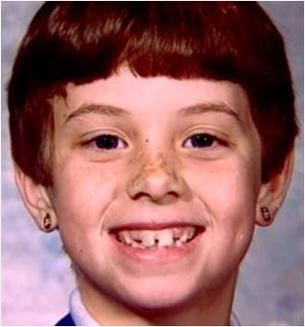
On September 17, 1984, an ordinary afternoon in Tucson, Arizona, turned into a nightmare for the family of eight-year-old Vicki Lynne Hoskinson.
Vicki had left home on her bicycle with a simple task: deliver a birthday card to her aunt. She never made it to the mailbox.
What followed was a massive search, a lengthy criminal investigation, years of legal battles, and ultimately the execution of the man convicted of taking her life.
A Short Trip That Never Ended
Vicki was eight years old when she disappeared. On that September afternoon, her mother asked her to ride her bicycle a short distance to mail a birthday card.
Until then, Vicki’s mother had been extremely cautious about letting her children go out alone. The family normally relied on a buddy system. That day, however, Vicki was allowed to make the brief trip by herself.
Roughly twenty minutes later, her mother became worried.
Vicki’s older sister, 11-year-old Stephanie, went outside to look for her. A few blocks away, she discovered Vicki’s bicycle abandoned beside the road.
Vicki was nowhere to be seen.
Her mother immediately contacted the Pima County Sheriff’s Department, and investigators quickly began organizing a large-scale search.
Witnesses Remembered a Suspicious Car
Investigators soon began interviewing people who had been in the neighborhood around the time Vicki vanished.
One important witness was Sam Hall, a coach at a nearby elementary school. Earlier that day, Hall had noticed a man sitting in a suspicious vehicle in an alley beside the school.
The driver’s behavior caught his attention. Hall noticed that the man appeared uncomfortable operating the vehicle’s manual transmission and was behaving strangely.
Instead of simply ignoring what he had seen, Hall memorized the vehicle’s license plate and wrote the number down.
After learning that a child was missing, he gave the information to police.
Other witnesses also reported seeing the same vehicle. One young girl recalled that the driver made an obscene gesture toward her, while another witness remembered the car backing into a telephone pole.
Those seemingly minor observations would eventually become important pieces of the investigation.
Police Identify Frank Atwood
The license plate information led investigators to Frank Jarvis Atwood, a 28-year-old man from Los Angeles.
A background investigation revealed that Atwood had previously faced serious criminal allegations, including kidnapping and child molestation. At the time of Vicki’s disappearance, he was reportedly on parole in California following a conviction involving the sexual abuse of an eight-year-old boy.
Investigators learned that Atwood’s vehicle was registered to his parents’ home.
Soon afterward, Atwood contacted his parents and claimed that his car had broken down in Texas. He asked them to send him money for repairs.
His mother wrote down the address where he was staying in Kerrville, Texas.
His father then took that information to a nearby payphone and contacted the FBI.
On September 20, federal agents located Atwood and his traveling companion, James McDonald, at a Texas mechanic’s shop. Atwood’s vehicle was seized for examination.
A Troubling Story About Blood
During questioning, Atwood admitted that he had been in the area where Vicki disappeared.
He claimed that he had been staying at a nearby park. According to his account, he left the park around 3 p.m. to obtain drugs and returned approximately two hours later.
The unexplained period became significant to investigators.
McDonald confirmed parts of Atwood’s story, but he also told authorities that Atwood had left after an argument and returned later with blood on his hands and clothing.
Atwood reportedly explained the blood by claiming that he had fought with and stabbed a drug dealer.
Investigators also located two men who said Atwood had stayed in their trailer. One of them, known by the nickname “Mad Dog,” also remembered seeing blood on Atwood and his clothing.
Atwood allegedly told the men that he had stabbed a drug dealer who had double-crossed him.
The Bicycle Became Important Evidence
Investigators did not find physical evidence inside Atwood’s vehicle that directly placed Vicki inside it.
However, examination of the vehicle and bicycle produced several important findings.
Experts discovered pink paint on the front bumper of Atwood’s car that was consistent with the paint on Vicki’s bicycle.
Damage to the vehicle’s lower section was also considered consistent with contact involving one of the bicycle’s pedals. Investigators further reported finding traces of nickel plating from the car’s bumper on the bicycle.
The area where Vicki’s bicycle had been discovered was examined again. Investigators found damage to a mailbox post at a height they believed was consistent with Atwood’s sports car.
They concluded that the vehicle may have struck Vicki’s bicycle there.
Atwood’s clothing from the day Vicki disappeared was never recovered.
A Kidnapping Charge
Ten days after Vicki vanished, Atwood was arrested and charged with kidnapping.
He was later extradited from Texas to Arizona.
Because the case had received enormous publicity in Tucson, the kidnapping trial was moved to Phoenix. Jury selection alone took almost six weeks.
At that stage, however, Vicki had still not been found.
Her family was left waiting for answers.
Vicki’s Remains Are Discovered
Nearly seven months after her disappearance, the investigation took another heartbreaking turn.
On April 12, 1985, a hiker discovered a human skull in the Sonoran Desert, approximately 20 miles from the location where Vicki’s bicycle had been found.
Investigators recovered additional remains from the area, although the passage of time and the condition of the remains made it impossible to determine the exact cause of death.
Dental records eventually confirmed what Vicki’s family had feared:
The remains belonged to Vicki Lynne Hoskinson.
For her family, the discovery ended the uncertainty over whether she was still alive, but it began another painful chapter — the search for justice.
The Murder Trial
Atwood’s murder trial began in January 1987.
On March 26, he was convicted of first-degree murder. Several weeks later, on May 8, he received a death sentence.
Atwood continued to deny responsibility.
During his years on death row, he maintained that investigators had tampered with evidence found on his vehicle. He also argued that there was no physical evidence proving that Vicki had been inside his car.
His legal appeals continued for decades, but the courts repeatedly rejected his efforts to overturn the conviction.
Decades on Death Row
While imprisoned, Atwood underwent significant personal changes. According to accounts from Vicki’s mother, he married, became involved with the Greek Orthodox Church, earned several college degrees, and wrote books.
Despite these changes, his conviction remained intact.
By April 2021, Atwood had exhausted his available appeals. Arizona authorities then moved toward carrying out the death sentence that had been imposed decades earlier.
Because of the date of his original conviction, Atwood was legally eligible to choose between lethal injection and gas inhalation. He did not make a selection, so lethal injection became the default method.
Final Legal Efforts
On May 3, 2022, the Arizona Supreme Court established June 8 as Atwood’s execution date.
A request for clemency was rejected later that month.
Atwood continued to maintain that he had not murdered Vicki.
In statements made shortly before his execution, he expressed sympathy toward Vicki’s family while still insisting that he was innocent.
The disagreement over his guilt never disappeared.
The Execution
On June 8, 2022, nearly 38 years after Vicki disappeared, Frank Jarvis Atwood was executed by lethal injection at the state prison in Florence, Arizona.
He maintained his innocence in his final statement.
At 10:16 a.m., Atwood was pronounced dead.
His execution brought the legal process to an end, but it could never undo what happened to Vicki or erase the loss experienced by her family.
Remembering Vicki Lynne Hoskinson
Vicki left home that September afternoon expecting to make an ordinary bicycle trip.
Instead, her disappearance triggered one of Arizona’s major criminal investigations of the era.
The case demonstrated how seemingly small observations — a remembered license plate, a suspicious vehicle, damage to a bicycle and car — could become crucial investigative leads.
Most importantly, it left behind the story of an eight-year-old girl whose life was cut tragically short.
For Vicki’s family, the years that followed were filled with grief, unanswered questions and a long wait for the justice system to reach its final conclusion.
Her name remains connected to a case that lasted decades, but at its heart, this was never simply a criminal case.
It was the story of a child who left home on a short errand and never returned.
This story is based on publicly available information and reported facts. It has been independently written and presented for informational purposes. Images, if any, belong to their respective owners.