A Family Vacation That Never Ended
In the summer of 1968, the Robison family left their home in Lathrup Village, Michigan, for what was supposed to be another peaceful summer vacation.
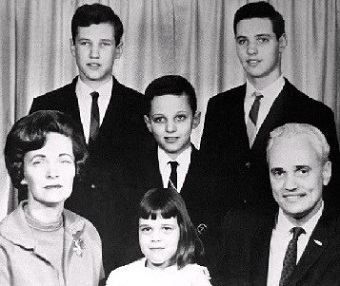
Richard and Shirley Robison had been returning to their secluded cottage in Good Hart for years. Their children—Richard Jr., Gary, Randall, and seven-year-old Susan—knew the property well. The cottage, known as Summerset, sat at the end of a private driveway surrounded by trees, not far from the Lake Michigan shoreline.
The family arrived on June 16 and settled into their usual vacation routine. They had no reason to believe that they would never return home.
A few days later, tragedy struck the wider group of vacationers when 18-year-old Norman James Bliss, a friend of Richard Jr., died in a motorcycle accident. Richard Sr. visited Bliss’s family afterward and explained that the Robisons were preparing to leave the area for a trip through Kentucky and Florida. He said they were not expected back at the cottage until around July 15.
That conversation would later become one of the reasons no one immediately questioned the family’s absence.
The Phone Calls That Came Before the Murders
On the morning of June 25, Richard Robison contacted his bank about an expected $200,000 deposit. Instead, he learned that the money had not arrived and that serious irregularities had appeared in his business accounts.
Richard was furious.
His attention quickly turned toward Joseph Raymond Scolaro III, a senior employee who had access to the company’s financial affairs. Richard began trying to reach him. Investigators later determined that he made or attempted seventeen calls to Scolaro that day.
Those calls became one of the most important details in the investigation.
The last confirmed sighting of the Robison family came later that afternoon, around 4:30 p.m., when two workers finished trimming trees around the cottage and left the property.
After that, the family disappeared from view.
But they had not left Good Hart.
Six People Murdered Inside Summerset
Investigators eventually concluded that the killings most likely happened during the early evening of June 25.
The attack began from outside the cottage. Five .22-caliber rifle shots were fired through a rear window toward Richard Robison as he sat inside.
The killer then entered the home.
One by one, the remaining members of the family were attacked. Shirley, Richard Jr., Gary, Randall, and Susan were shot with a combination of a .22-caliber rifle and a .25-caliber pistol. Richard and young Susan had also suffered blows from a claw hammer.
There were few signs of a prolonged struggle.
A single bloody footprint was discovered inside the cottage, suggesting investigators were dealing with one attacker. The killer appeared to have closed the curtains, attempted to conceal the bullet damage to the window, turned on the heat, and locked the cottage before leaving.
A handwritten message had also been left on a piece of paper towel attached to the door, making the scene even more confusing.
The family was simply gone from everyone’s view, and nothing immediately suggested that six people were lying dead inside the secluded cottage.
A Month Before Anyone Found Them
The Robisons were not discovered the next day—or even the next week.
Their bodies remained inside Summerset for nearly a month.
On July 22, a neighbor noticed a powerful odor while spending time outside with friends. The smell appeared to be coming from the direction of the Robison cottage.
The resort’s owner and caretaker, Chauncey Bliss, went to investigate.
Both doors were locked.
He forced his way inside and found the horrifying scene.
All six members of the Robison family were dead.
The delay had badly affected the condition of the bodies and destroyed some potential evidence. Investigators nevertheless began reconstructing the crime from the scene, the weapons, shell casings, witness accounts, and the family’s business affairs.
The killings did not appear to be a robbery. Although a valuable ring belonging to Shirley was missing, other valuables and money were left behind.
Investigators increasingly believed the killer was someone who knew the family—or at least had a reason to target them.
Joseph Scolaro Becomes the Prime Suspect
Within weeks, investigators focused heavily on Joseph Scolaro.
He had worked for Richard Robison’s companies since 1965 and had been placed in a position of responsibility while Richard was away. More importantly, investigators discovered financial activity that appeared to connect Scolaro to missing company funds.
His movements on June 25 also raised questions.
According to investigators, Scolaro left his office after receiving the first call from Richard. He was then unaccounted for during a critical portion of the day, and the alibis he initially provided did not withstand scrutiny.
Another detail was even more striking: a pair of Scolaro’s boots appeared to match the bloody footprint found inside the cottage.
Investigators also examined his firearms.
Scolaro owned .22-caliber rifles, and he had purchased .25-caliber pistols months before the murders. The weapons were similar to those believed to have been used at Summerset. He claimed that some of the firearms had been given away, but investigators were unable to account for all of them.
He also failed two polygraph examinations, although polygraph results are not themselves proof of guilt.
Then, in November 1969, investigators found another significant piece of evidence.
Shell casings recovered from a firing range connected to Scolaro were determined to have come from the same type of AR-7 rifle used in the Robison murders.
Investigators believed they had finally built a case against him.
The Case That Never Reached a Courtroom
By December 1969, Michigan State Police and Emmet County investigators had prepared a massive case file—roughly 700 pages—identifying Scolaro as the suspected killer.
But there was a problem.
The actual murder weapons had never been recovered, and investigators did not have physical evidence placing Scolaro inside Summerset Cottage.
Prosecutors ultimately decided there was not enough evidence to bring charges.
Scolaro remained free.
The investigation did not end there. A few years later, Oakland County officials reopened the case and began working toward an indictment.
Scolaro never faced that indictment.
On March 8, 1973, he died by suicide inside his office. Two notes were discovered. In one, he admitted to financial crimes and described himself as a fraud and a liar.
At the end of the note, however, he denied having anything to do with the Robison murders.
He was never prosecuted, and therefore never convicted.
An Unsolved Case That Remains Open
The Robison family was buried in Oakland County on July 26, 1968. Six members of one family were gone, and the person investigators believed was responsible would never stand trial.
Scolaro remains the central suspect in the case, but the legal record never established his guilt through a conviction. His death left investigators unable to answer some of the most important questions surrounding the murders.
Was Scolaro acting alone?
Was someone else involved?
And what exactly happened inside Summerset Cottage during those final moments of the Robison family’s vacation?
More than five decades later, the murders remain officially unsolved.
The evidence pointed investigators toward one man, but the courtroom never had the opportunity to determine what truly happened. The Robison family left for Good Hart expecting another summer together. Instead, June 25, 1968, became the final day all six would ever see.
This story is based on publicly available information and reported facts. It has been independently written and presented for informational purposes. Images, if any, belong to their respective owners.